
Pu Luong is home to communities of the Black Thai, known in their own language as Tai Dam. Their history is closely connected to the mountain valleys of northwestern Vietnam, where settlements, rice farming and distinctive architectural traditions developed over centuries.
The Black Thai belong to the wider Tai-speaking peoples of mainland Southeast Asia. Their traditional homeland includes the historic region known as Sip Song Chau Tai, meaning “Twelve Tai Principalities”, in what is now northwestern Vietnam.
Their villages are known for wooden stilt houses, wet-rice cultivation, handwoven textiles and a rich tradition of oral storytelling. These are not isolated customs: they reflect how communities organised their homes, work, family relationships and local economy.
Today, Pu Luong offers an opportunity to explore this culture in its everyday setting — through village paths, working rice fields, traditional homes and the people who live here.

The Black Thai People
of Pu Luong
A History Shaped by the Mountains

Long before modern national borders were established, Tai-speaking communities lived across the mountainous valleys of mainland Southeast Asia. The Black Thai developed a strong historical presence in northwestern Vietnam, particularly in the region associated with Sip Song Chau Tai.
The name Tai Dam is commonly translated as “Black Thai” and is associated with the group's traditional dark clothing. The Black Thai have their own language and cultural identity, distinct from those of neighbouring ethnic communities.


Historically, many communities settled in valleys where water and suitable land made wet-rice cultivation possible. Village life depended on knowledge of the terrain, water management, seasonal farming and cooperation among households.
The region's history was also shaped by changing political powers, migration and contact with neighbouring peoples. Rather than following one simple migration route, Tai Dam history reflects centuries of movement and interaction across a region that today spans several countries.
Daily Life in Pu Luong
The landscape of Pu Luong is also a working landscape. Rice cultivation, water management, traditional housing and household crafts have all influenced how Black Thai villages are organised.


Rice Farming
The Architecture of Stilt Houses
Food & the Family Table
Life Around the Home
Rice cultivation has shaped life in Pu Luong for generations. Thai farmers grow rice on terraced fields, relying on seasonal rainfall and irrigation systems, including bamboo waterwheels that lift water from streams to the fields.
Pù Luông has two beautiful golden rice seasons each year, usually in May and September. During these special months, the terraced rice fields transform into a spectacular sea of golden yellow as the rice ripens before harvest. Outside these periods, the landscape changes from flooded paddies and bright green rice shoots to lush green terraces. ,
Traditional Black Thai houses stand on wooden posts, raising the living floor above the ground. This design helps protect the home from ground moisture and allows air to circulate beneath the floor.
The house is traditionally built with a timber frame, bamboo and a broad roof. Some Black Thai houses feature a roof shaped like a tortoise shell, reflecting a local legend that a turtle taught people how to build their homes.
Traditional houses may also have designated spaces for cooking, family activities and ancestral worship.
Every part of the house reflects a combination of practical building knowledge, local materials and cultural beliefs.
Food in Pu Luong reflects the crops, forests and streams surrounding local villages. Families grow rice, vegetables, beans and bamboo shoots, and gather seasonal wild greens. Meals may include stream fish, free-range chicken, local pork and Cổ Lũng duck, a local breed known for its firm, flavourful meat.
One traditional speciality is cơm lam: sticky rice cooked inside bamboo tubes over an open fire. Grilled chicken seasoned with mắc khén, an aromatic spice used in Thai cooking, and stream fish grilled with herbs are also popular local dishes. Meals are often shared around a family table, with several dishes served together.
The area surrounding the house is an important part of the household economy. Vegetables and fruits are grown close to home, while chickens and pigs provide food for the family. Fish ponds are also parts of local yards, making use of the water available around the household.
Water management is connected to agriculture in the mountainous landscape. Traditional bamboo water wheels, found along local streams and rivers, use the force of flowing water to lift it into elevated channels. From there, it can be directed towards rice fields for irrigation.
Many everyday activities depend on the careful use of local resources, linking the household to the land, streams and agricultural fields around it.
Culture & Traditions
For generations, the story of the Black Thai people has been woven into the fabric of everyday life — carried through ancestral customs, family gatherings and the rhythms of village life. It is a heritage shaped by time, where the past remains present in the hands, hearts and voices of those who keep it alive.


Brocade: Woven by Hand
Why “Black Thai”?
Traditional Dance & Singing
Family Ceremonies & Village Festivals
Traditional brocade weaving is an important part of Black Thai cultural identity in Pu Luong. Using looms and colourful threads, women create textiles for clothing, scarves, blankets and other household items. The craft is traditionally passed from older women to younger generations, preserving techniques and patterns through practice.
Motifs inspired by birds, rice plants, the sun and flowing water reflect the natural world and local cultural beliefs. Traditionally woven textiles also hold a special place in wedding preparations, when a bride’s handmade garments can represent her skill and care for her future household.
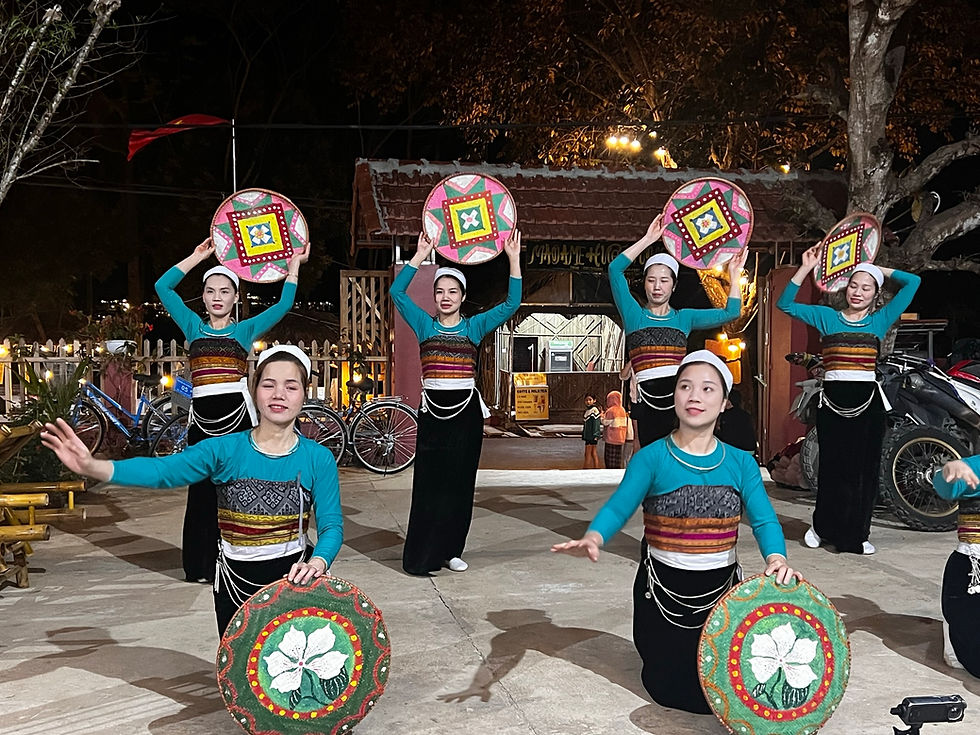
The name “Black Thai” is commonly associated with distinctive elements of traditional dress, especially women’s clothing and hairstyles. Women traditionally wear a fitted blouse with a long dark skirt, often accompanied by silver jewellery and an embroidered piêu headscarf. The scarf’s colourful patterns stand out against the darker clothing and can take considerable time and skill to create.
Traditional clothing also carries meaning during important family occasions. In some Black Thai communities, marriage is marked by tằng cẩu, a custom in which a married woman’s hair is arranged in a bun on top of her head. Customs vary between communities, but clothing and textiles remain closely connected to family identity and significant life events.
Music and dance are important forms of expression in Thai communities. Traditional singing, known as khắp, combines poetic lyrics with melody and may be accompanied by musical instruments.
Group dances, including xòe, bring people together in coordinated movements, often forming circles in which participants dance side by side. In Thanh Hoa, another distinctive performance tradition is khua luống, in which performers strike a hollowed wooden trough with wooden pestles to create rhythmic patterns. The sound can accompany dancing and communal celebrations, linking performance with everyday life and local customs.
Family ceremonies and village festivals bring people together to mark important moments, express gratitude and seek health, prosperity and a good harvest. Depending on the community, ceremonies may include offerings, traditional foods, prayers and the participation of respected ritual specialists.
One example from Thanh Hoa is the Chá Mùn festival of the Black Thai community in Yên Thắng. It includes ceremonial offerings and rituals connected with spiritual well-being, alongside folk performances, music and communal activities. The festival was recognised as part of Vietnam’s national intangible cultural heritage in 2024. Although it is a specific local tradition rather than a festival shared by every Black Thai village, it illustrates the continuing role of collective ceremonies in community life.